DEF STAN 00-35, MIL-STD-810 or DO-160: Which Standard Do You Need?
Buyer Guides · 3 November 2026
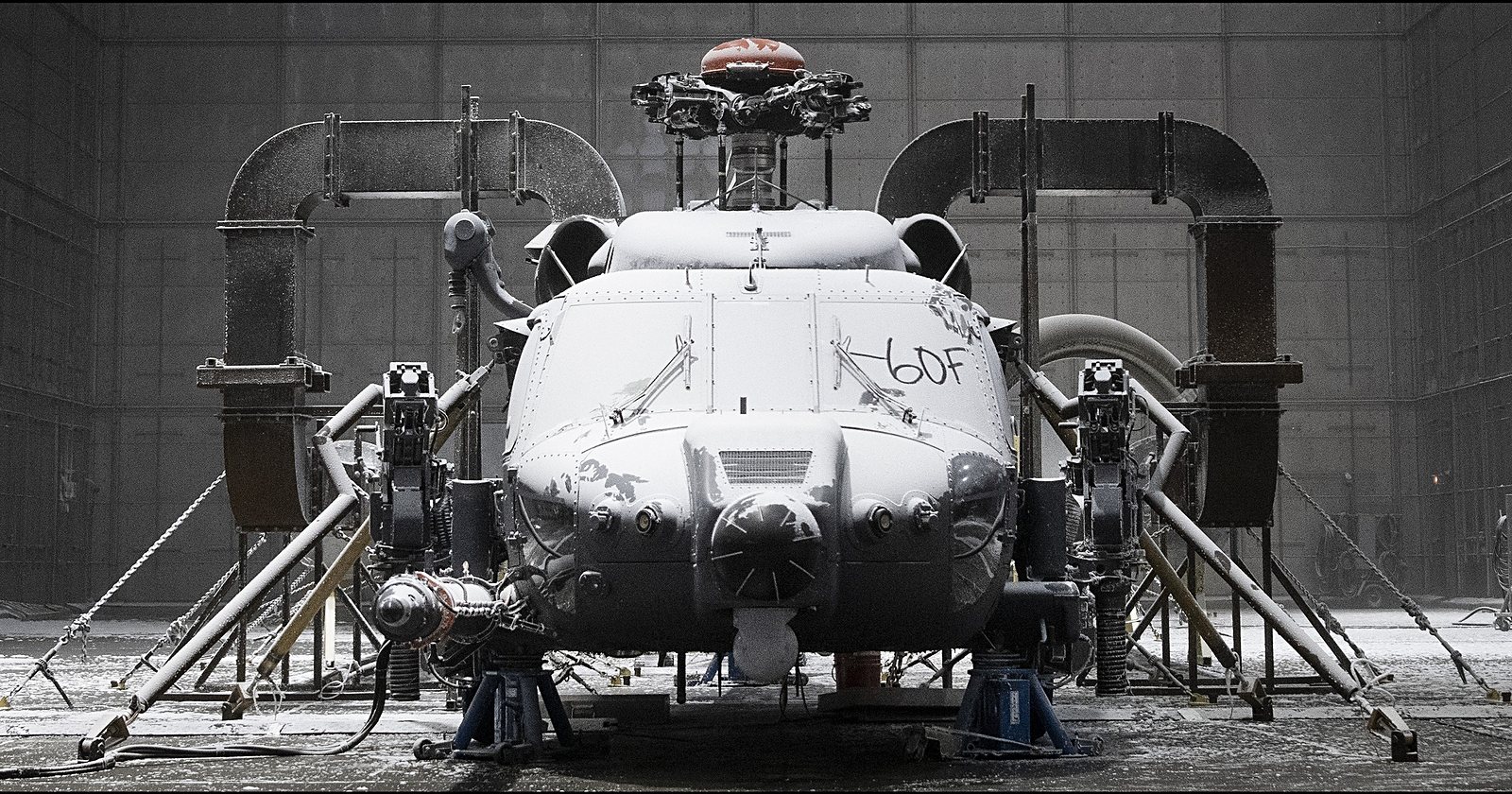
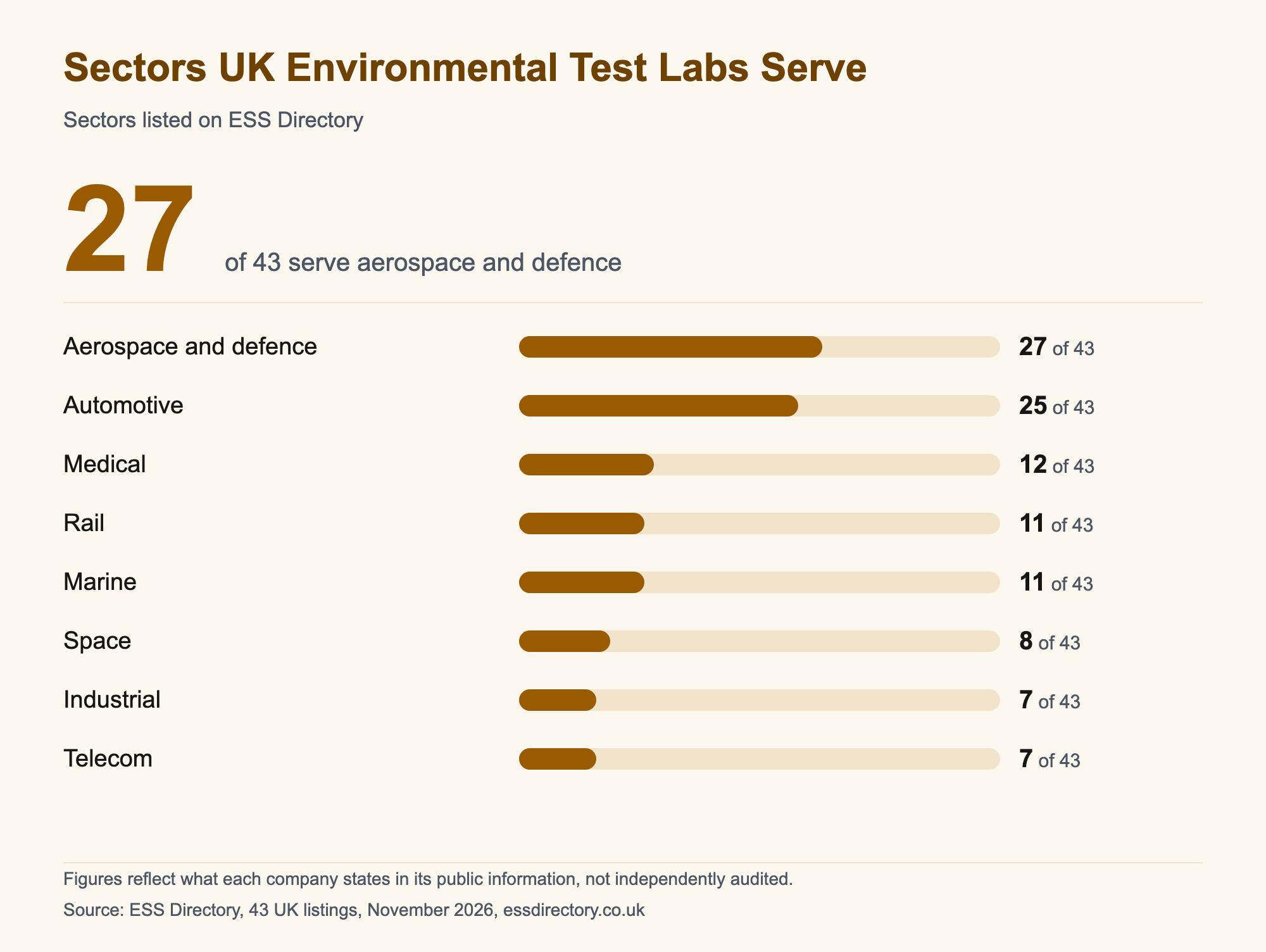
Product specifications often say "tested to MIL-STD-810" or "environmentally tested to DEF STAN 00-35" without saying what that means for your product. These standards are not interchangeable, and each one tells a lab what to test and how. This guide explains how the main environmental test standards differ, which sectors use them, and how many of the 43 UK labs listed on ESS Directory state each one.
MIL-STD-810
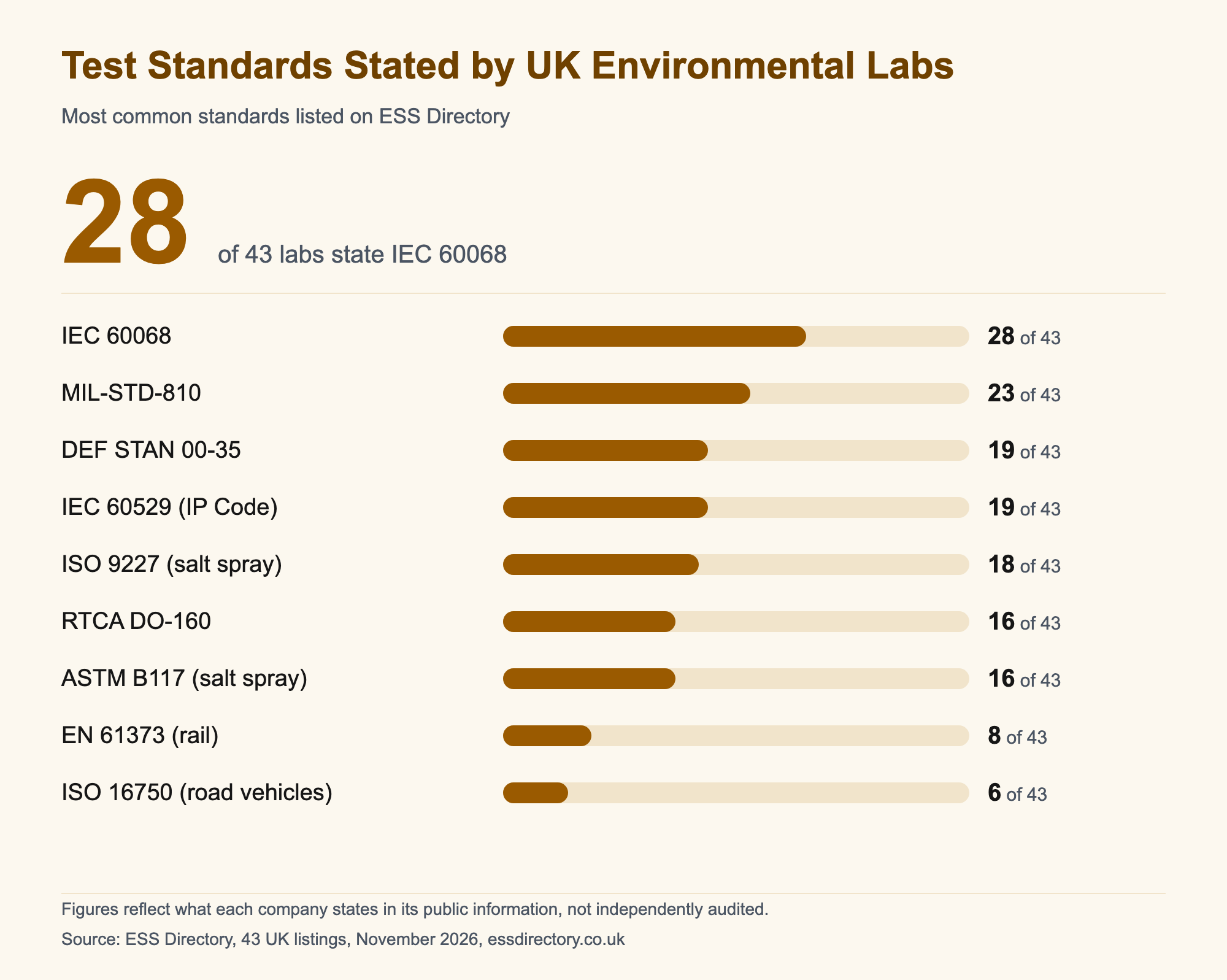
MIL-STD-810 is a United States Department of Defense standard, titled Environmental Engineering Considerations and Laboratory Tests. It is a set of test methods, covering conditions such as temperature, humidity, vibration, shock, sand and dust, salt fog and altitude. Its key idea is tailoring: the test methods are meant to be tailored to the environments the equipment will face over its life, not applied as a fixed list. 23 of the 43 listed labs state MIL-STD-810. It is requested by defence customers and by many commercial suppliers who want a recognised toughness benchmark.
DEF STAN 00-35
DEF STAN 00-35 is the UK Ministry of Defence's Environmental Handbook for Defence Materiel, published in several parts that cover management of the environmental programme, test methods and the natural and induced environments equipment meets. It is written for UK defence programmes, so a contract that cites it is asking for the UK approach to deriving and running the test programme. 19 listed labs state it. Check which issue and which parts your contract calls up, because the requirement is whatever the contract says.
RTCA DO-160
RTCA DO-160, Environmental Conditions and Test Procedures for Airborne Equipment, is the main environmental standard for civil aircraft equipment. Its European counterpart is EUROCAE ED-14. It is organised in numbered sections, each with categories to match where the equipment sits in the aircraft: for example sections on temperature and altitude, humidity, shock, vibration, waterproofness, fluids, sand and dust, fungus, salt fog and icing. 16 listed labs state DO-160. Some sections cover electrical and electromagnetic tests, which are a separate specialism, so a full DO-160 programme may involve both an environmental lab and an EMC test lab.
IEC 60068 and IEC 60529
IEC 60068 is the general-purpose series of environmental testing standards, with a part for each test: cold, dry heat, sine and random vibration, shock, change of temperature and damp heat, among others. It is the usual reference for commercial and industrial electronics, and the most commonly stated standard on ESS Directory, with 28 of 43 labs. IEC 60529 defines the IP code for ingress protection against dust and water, and 19 labs state it.
Sector standards
Several sectors have their own standard, written for the conditions that matter in that sector:
- ISO 16750 covers environmental conditions and testing for electrical and electronic equipment in road vehicles (6 listed labs).
- EN 61373 covers shock and vibration testing for railway rolling stock equipment (8 listed labs).
- ISO 9227 and ASTM B117 cover salt spray corrosion testing (18 and 16 listed labs respectively).
Which one do you need?
The right standard is almost always set by someone else: your customer, your contract or your certification route. A practical way to settle it:
- Check the contract or customer specification, and note the exact standard, issue and test methods.
- If it says only "environmentally tested", ask which standard and which conditions are expected, in writing.
- If you are setting your own requirement, pick the standard of the sector you sell into, then tailor the levels to where the product will really be used.
- Give the lab the standard, the levels and the pass criteria when you ask for a quote.
Labs can often run more than one standard on the same product. 14 of the 43 listed labs state all three of MIL-STD-810, DEF STAN 00-35 and RTCA DO-160.
Quick-reference checklist
- Find the standard, issue and test methods your contract names
- Ask for the levels and pass criteria in writing if they are not stated
- Check the lab lists the standard and that your test is within its accredited scope
- Ask whether electrical or EMC tests in the same standard need a different lab
- Ask for the report format your customer expects
Figures come from ESS Directory listings as of November 2026 and reflect what each company states in its public information. They are not independently audited.
Where to go for more
The UK Ministry of Defence publishes defence standards through Defence Standardization. RTCA publishes DO-160 and EUROCAE publishes ED-14. The IEC and ISO publish the IEC 60068, IEC 60529 and ISO 16750 series, and UKAS publishes lab accreditation schedules.
Find environmental test labs on ESS Directory
Browse military and aerospace environmental testing, automotive environmental testing and the other test categories, and filter labs by Test Standards. Save the labs that fit to your shortlist and send one enquiry to the whole shortlist at once. Our guide to choosing a UK environmental test lab covers the wider questions to ask.
Figures and data in this article are drawn from ESS Directory's own dataset of UK environmental test lab listings, and may be cited with attribution to ESS Directory and a link to this article.
For press enquiries about ESS Directory, contact ess@essdirectory.co.uk.
Listings related to this article

3C Test
Silverstone, Northamptonshire
3C Test in Silverstone is an Applus+ Laboratories EMC and environmental test lab serving automotive, EV battery, aerospace and defence, and consumer and industrial electronics customers. Its environmental work covers high and low temperature, thermal shock, thermal cycling, humidity, salt spray, altitude, sine and random vibration, shock, drop and topple, and combined climatic and vibration testing. Standards include BS EN 60068, ISO 16750, MIL-STD-810, DEF STAN 00-35, RTCA DO-160 and EN 61373. It is UKAS-accredited to ISO 17025, lab number 1204. A 200 kN shaker can be combined with a large climatic chamber for EV battery pack testing.
- Temperature (Hot/Cold)
- Humidity/Damp Heat
- Thermal Cycling
- Thermal Shock

Alphatech
Haverhill, Suffolk
Alphatech in Haverhill runs an independent UKAS-accredited environmental test lab alongside its chamber sales, hire and service business. The lab covers high and low temperature, damp heat, thermal shock, sine and random vibration, shock, bump, drop and topple, HALT and HASS, IP dust and water ingress up to IPX9K, neutral salt spray and altitude. Standards include BS EN 60068, IEC 60529, ISO 20653, ISO 16750, MIL-STD-810, DEF STAN 00-35, RTCA DO-160 and EN 61373. It is accredited to ISO 17025, lab number 2645, with shakers of up to 40 kN. Customers can stay on site during testing.
- Temperature (Hot/Cold)
- Humidity/Damp Heat
- Thermal Cycling
- Thermal Shock

BAE Systems Faraday Test Centre
Rochester, Kent
BAE Systems Faraday Test Centre in Rochester is a UKAS-accredited environmental and EMC test facility that takes confidential test work from external customers as well as BAE Systems. Environmental capabilities cover temperature, thermal shock, humidity, sine, random and mixed-mode vibration, shock, bump, drop, acceleration, altitude, rapid and explosive decompression, driving rain, immersion, salt fog, icing, fluid contamination and combined temperature, altitude and humidity. Tests run to MIL-STD-810, RTCA DO-160, DEF STAN 00-35 and BS EN 60068. It is accredited to ISO 17025, lab number 0047, with 11 climatic chambers and shakers of up to 118.6 kN.
- Temperature (Hot/Cold)
- Humidity/Damp Heat
- Thermal Cycling
- Thermal Shock

Environmental Test Services (ETS)
Reading, Berkshire
Environmental Test Services is an independent, owner-managed environmental test laboratory in Reading, Berkshire. It runs vibration, shock, temperature and humidity, altitude and decompression, salt spray and IP testing, including combined temperature and vibration, thermal shock, icing and drop tests. Work is carried out to DEF STAN 00-35, MIL-STD-810, RTCA DO-160 and the IEC 60068 series, with IP testing to IEC 60529. The laboratory is UKAS-accredited to ISO 17025, lab number 1909. Facilities include a walk-in climatic chamber of 1.8 m x 2.4 m x 2.4 m and electromagnetic vibrators of up to 28 kN. Tested product types include aerospace, marine, satellite, telecoms and motor vehicle equipment.
- Temperature (Hot/Cold)
- Humidity/Damp Heat
- Thermal Cycling
- Thermal Shock
HORIBA MIRA Basildon
Basildon, Essex
HORIBA MIRA Basildon, at Quatro Park in Basildon, Essex, tests components and systems under vibration, climatic cycling, thermal shock, mechanical shock, corrosion and ingress protection. Facilities include 13 environmental chambers from 180 to 2,000 litres, two 36,000-litre walk-in chambers, electromagnetic vibrators and large battery shakers, including an IMV K350 with 900 kN shock thrust. Work is carried out to IEC 60068, MIL-STD-810, DEF STAN 00-35 and RTCA DO-160, including electric vehicle battery packs and modules. The site is UKAS-accredited to ISO 17025, lab number 2654, and serves the automotive, defence and aerospace sectors.
- Temperature (Hot/Cold)
- Humidity/Damp Heat
- Thermal Cycling
- Thermal Shock

Javer Labs
Nottingham, Nottinghamshire
Javer Labs in Nottingham is a laboratory specialising in fungus resistance and mould growth testing. It tests aerospace and defence components and equipment to MIL-STD-810 Method 508, RTCA DO-160 Section 13, BS EN 60068-2-10 and DEF STAN 00-35, with ISO 846 available on request. The laboratory is UKAS-accredited to ISO 17025 for fungus resistance testing, lab number 31736, and is registered on JOSCAR. It is based at Nottingham Science Park and plans to add further environmental tests, starting with susceptibility to fluids.
- Fungus/Mould Growth

JCS Technology
Weston-super-Mare, Somerset
JCS Technology in Weston-super-Mare is an independent test laboratory offering environmental, mechanical, fire and microbiological testing. Its environmental work covers temperature and humidity, thermal shock, altitude, icing, solar radiation, xenon arc and UV weathering, salt spray, toxic and mixed gas corrosion, sand and dust, fluid susceptibility and mould growth. Standards include BS EN 60068, MIL-STD-810, DEF STAN 00-35, RTCA DO-160, ASTM B117 and ISO 9227. The laboratory is UKAS-accredited to ISO 17025, lab number 2154, and certified to ISO 9001. Sectors served include aerospace, defence, automotive, rail, marine, energy, medical and telecommunications.
- Temperature (Hot/Cold)
- Humidity/Damp Heat
- Thermal Cycling
- Thermal Shock

Leonardo Environmental Test Lab (Edinburgh)
Edinburgh
Leonardo Environmental Test Lab in Edinburgh carries out climatic, dynamic and EMC testing at Leonardo UK's Crewe Toll site. Climatic tests cover high and low temperature from -60°C to +180°C, damp heat, thermal shock, altitude to 100,000 ft, rapid decompression, solar radiation, salt mist, immersion, drip and fluid contamination. Dynamic tests include sine and random vibration on shakers up to 13,000 lbf, combined temperature and vibration, shock, bump and drop. Standards include IEC 60068, MIL-STD-810, DEF STAN 00-35, RTCA DO-160 and EN 61373. The lab is UKAS-accredited to ISO 17025, lab number 0461, with climatic chambers up to 4 m x 1.5 m x 1.8 m.
- Temperature (Hot/Cold)
- Humidity/Damp Heat
- Thermal Cycling
- Thermal Shock

PARC (Product Assessment & Reliability Centre)
Bideford, Devon
PARC (Product Assessment & Reliability Centre) in Bideford, Devon, is an environmental test laboratory and part of the Apave group through Sopemea. It runs high and low temperature, damp heat, thermal shock, altitude, icing, rain, salt spray, IP, vibration, shock, bump and drop tests to IEC 60068, MIL-STD-810, DEF STAN 00-035, RTCA DO-160, ISO 16750 and EN 61373. The lab is UKAS-accredited to ISO 17025, lab number 2379. Capacity includes temperature chambers of up to 2.7 m x 2.7 m x 2.7 m and a vibration system with 89 kN random force. It serves aerospace, defence, automotive, rail, marine, oil and gas and telecoms customers.
- Temperature (Hot/Cold)
- Humidity/Damp Heat
- Thermal Cycling
- Thermal Shock

Particle Technology
Hatton, Derbyshire
Particle Technology in Hatton, Derbyshire, runs sand and dust and ingress protection testing alongside particle and filter analysis services. Its UKAS ISO 17025 scope, lab number 4109, covers turbulent dust and driving sand and dust to DEF STAN 00-035, MIL-STD-810 Method 510 and RTCA DO-160 Section 12, and IP dust and water testing to IEC 60529 and ISO 20653. Facilities include a 12.5 x 4 x 6 m blowing and turbulent dust chamber with a 4 m high access door, and a second 4 x 4 x 3 m dust chamber. It works with defence, aerospace, automotive, medical and telecommunications customers.
- Blowing Sand and Dust
- IP Dust (IP5X/IP6X)
- IP Water (IPX1 to IPX9K)

Resonate Testing
Newry, County Down
Resonate Testing in Newry provides vibration, shock, climatic, ingress protection, battery and fire testing from a single facility. Tests include sine and random vibration with combined climatic conditioning, classical and pyroshock, drop, temperature, humidity, thermal shock, altitude to 100,000 ft, IP dust and water, salt spray, sand and dust, rain and fluid susceptibility. Main standards are IEC 60068, MIL-STD-810, RTCA DO-160, DEF STAN 00-35, ISO 16750 and IEC 60529. The lab is UKAS-accredited to ISO 17025, lab number 9373, and is an ISTA Certified Laboratory. Capacity includes a 70 kN shaker. It serves space, aerospace, defence, automotive, energy, medical and industrial customers.
- Temperature (Hot/Cold)
- Humidity/Damp Heat
- Thermal Cycling
- Thermal Shock

Smithers Shawbury
Shrewsbury, Shropshire
Smithers Shawbury in Shrewsbury is a materials testing laboratory for plastics, rubber and composites that also carries out environmental exposure tests. Its environmental work covers fluid contamination and susceptibility testing with hydraulic fluids, lubricating oils, solvents, de-icing agents and other fluids to MIL-STD-810, DEF STAN 00-35 and RTCA DO-160, salt spray to ASTM B117 and ISO 9227, ozone cracking resistance and heat resistance. Samples can be materials or complete parts, with functional checks after exposure. The laboratory is UKAS-accredited to ISO 17025, lab number 0067. It also offers chemical analysis, mechanical and physical testing and thermal analysis of polymers.
- Fluid Contamination
- Salt Spray/Salt Fog

TÜV SÜD Fareham
Fareham, Hampshire
TÜV SÜD Fareham runs climatic and vibration environmental test facilities at its Hampshire headquarters alongside EMC, radio and electrical safety labs. Its tests cover high and low temperature, damp heat, thermal shock, altitude, rapid decompression, salt corrosion, icing, fluid contamination, water ingress to IPX8, sine and random vibration, shock, drop and transit testing, to standards including IEC 60068, MIL-STD-810, DEF STAN 00-35, RTCA DO-160 and EN 61373. The lab is UKAS-accredited to ISO 17025, lab number 0141. Capacity includes climatic chambers up to 5.0 m x 6.0 m x 4.0 m and shakers up to 151 kN. Product groups served include aerospace, defence, rail, marine, satellites and medical devices.
- Temperature (Hot/Cold)
- Humidity/Damp Heat
- Thermal Cycling
- Thermal Shock

ZF Automotive UK Test & Validation
Solihull, West Midlands
ZF Automotive UK Test & Validation in Solihull offers EMC, environmental and materials testing for automotive and other industry components. Its environmental scope covers dry heat, low temperature, humidity, thermal cycling and thermal shock, salt mist, IP dust and water to IPX9K, icing, fluid contamination, low pressure, and sine, random, shock, bump and drop testing, with combined temperature and vibration. Standards include IEC 60068, MIL-STD-810, DEF STAN 00-35, RTCA DO-160, ISO 16750 and EN 61373. The lab is UKAS-accredited to ISO 17025, lab number 0332. Capacity includes 2,500-litre climatic chambers and a 66 kN shaker. It serves automotive, aerospace and rail.
- Temperature (Hot/Cold)
- Humidity/Damp Heat
- Thermal Cycling
- Thermal Shock