HALT, HASS and Stress Screening: What Each One Does and When to Use It
Buyer Guides · 3 November 2026
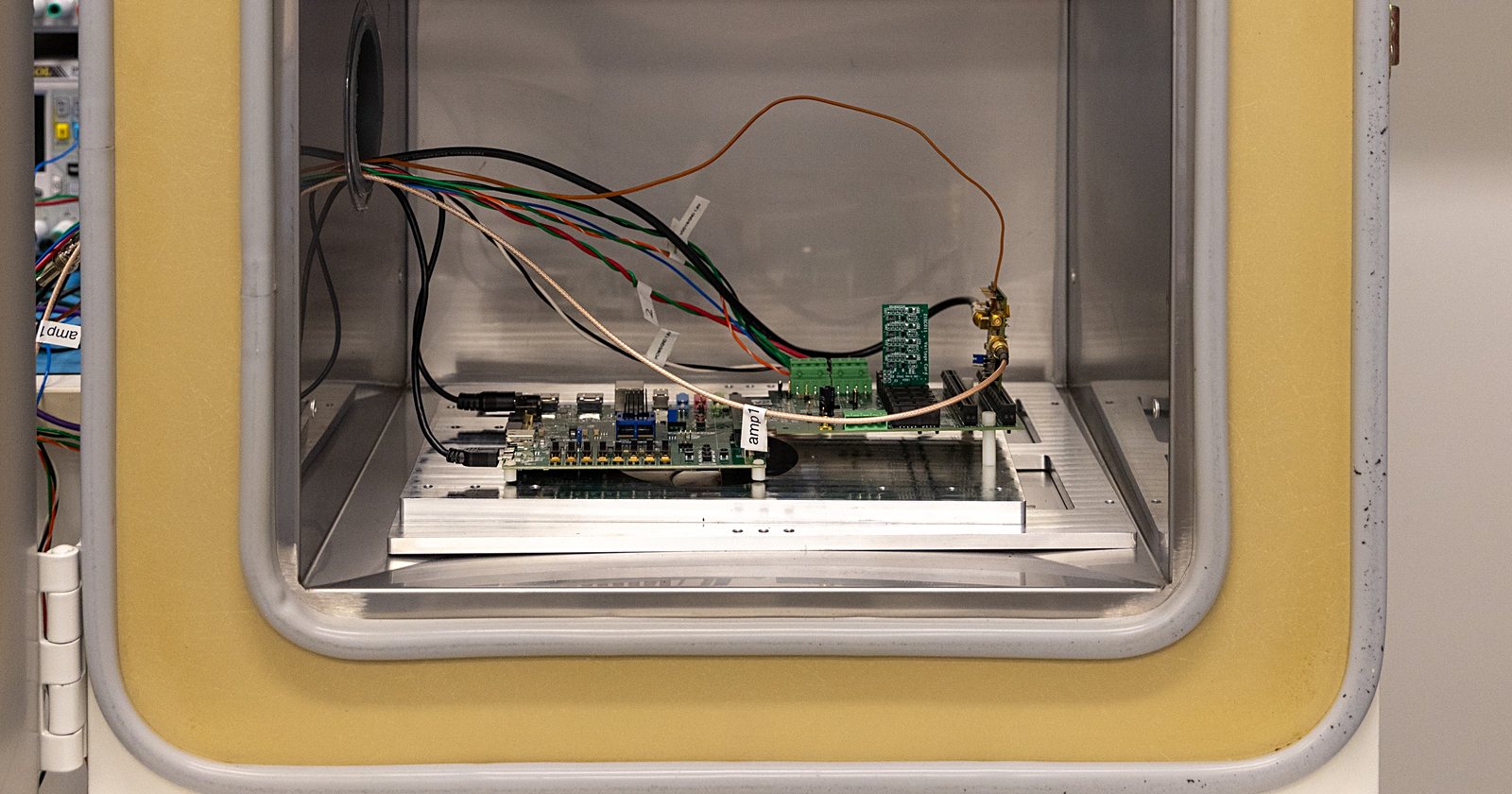
HALT, HASS and environmental stress screening are often mentioned together and often confused. They share a family of stresses, mainly temperature change and vibration, but they are used at different points in a product's life and answer different questions. This guide explains what each one does, how they differ from standard qualification tests, and how many of the 43 UK environmental test labs on ESS Directory list them.
HALT: find the weak points in a design
HALT stands for highly accelerated life test. It is run on a small number of samples during development. The product is exposed to stresses in steps, such as cold, heat, rapid temperature change and vibration, and then to combinations of them, with the levels pushed well beyond the specification until something stops working or breaks. The aim is not to pass or fail. It is to find the operating limits and the destruct limits, and to expose weak points while the design can still be changed. A HALT chamber typically combines fast thermal change with multi-axis vibration. HALT is listed by 2 of the 43 labs.
HASS: screen every unit in production
HASS stands for highly accelerated stress screening. It is a production test. Each unit, or a sample, is run through a short profile of temperature change and vibration, with levels set from what HALT found, so that they are demanding enough to precipitate defects in manufacturing but are intended not to use up the life of good units. It catches workmanship problems such as weak solder joints, marginal components and assembly faults, and unlike HALT it has a pass or fail criterion: the product must work during and after the screen. HASS is usually set up after HALT has defined the limits. HASS is listed by 1 of the 43 labs.
Environmental stress screening: the traditional production screen
Environmental stress screening is the older, more conventional production screen. It typically uses temperature cycling and random vibration at levels chosen to find defects without damaging good product, and military handbooks such as MIL-HDBK-344 describe it for electronic equipment. Traditional screening profiles tend to be gentler and longer than HASS profiles. Production stress screening is listed by 1 of the 43 labs.
How they differ from qualification tests
A qualification test, such as a MIL-STD-810 or IEC 60068 test, checks that a design meets a stated requirement under defined conditions. It is pass or fail against a specification. HALT is exploratory and goes beyond the specification, and HASS and stress screening are about manufacturing quality, not design. They do not replace qualification, and qualification does not replace them. Many programmes use all of them: HALT during development, qualification before release and screening in production.
| HALT | HASS | Stress screening | Qualification test | |
|---|---|---|---|---|
| Stage | Development | Production | Production | Before release |
| Question | Where does it fail? | Is this unit built well? | Is this unit built well? | Does it meet the spec? |
| Samples | A few | Every unit or a sample | Every unit or a sample | A defined number |
| Levels | Beyond the specification | Derived from HALT limits | Set by the screening profile | Set by the standard |
| Result | Limits and weak points | Pass or fail | Pass or fail | Pass or fail |
The stresses behind them
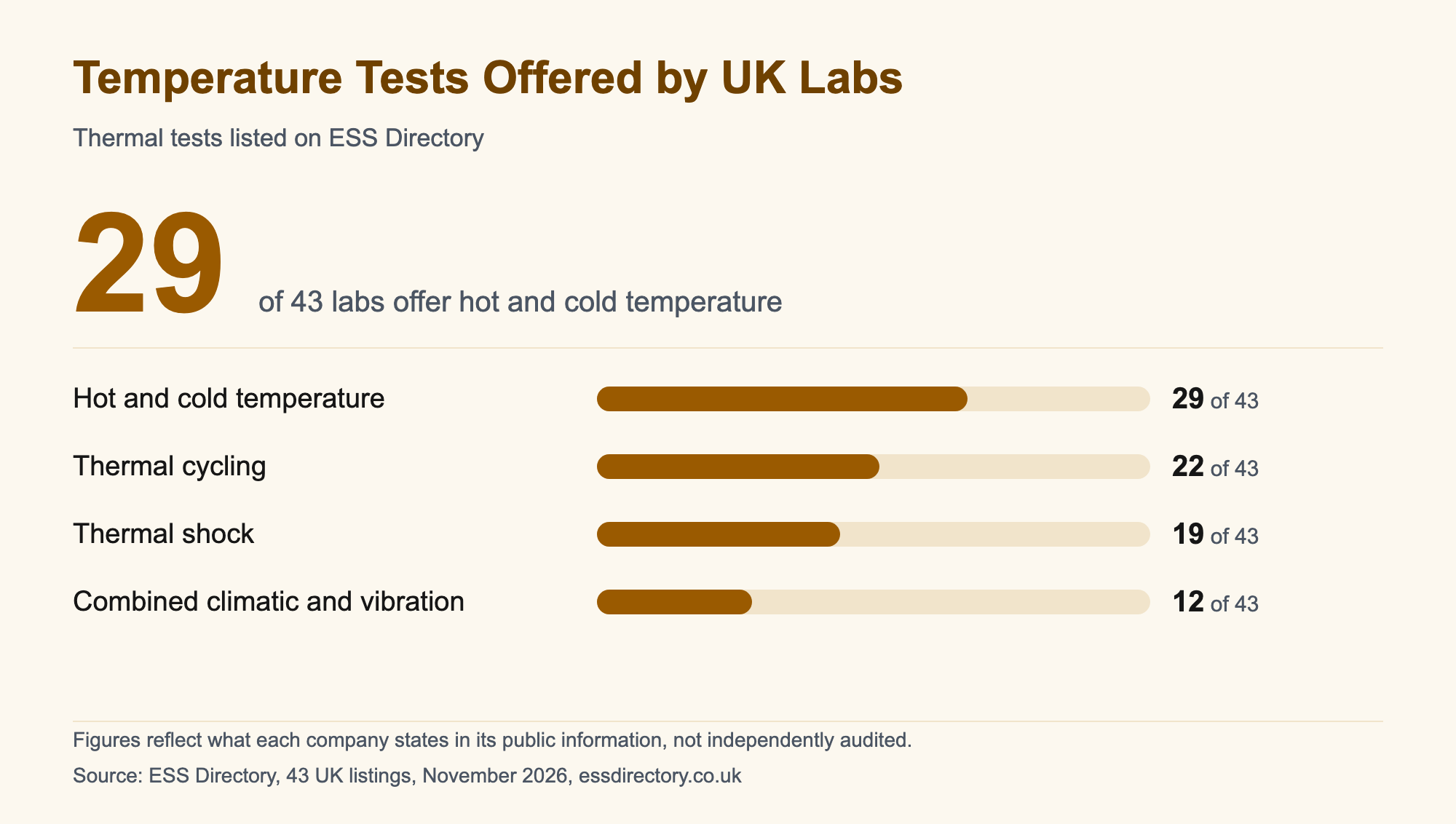
All three build on tests that ESS Directory labs list individually. Thermal change is the common thread: 22 of the 43 labs list thermal cycling, 19 thermal shock and 12 combined climatic and vibration testing.
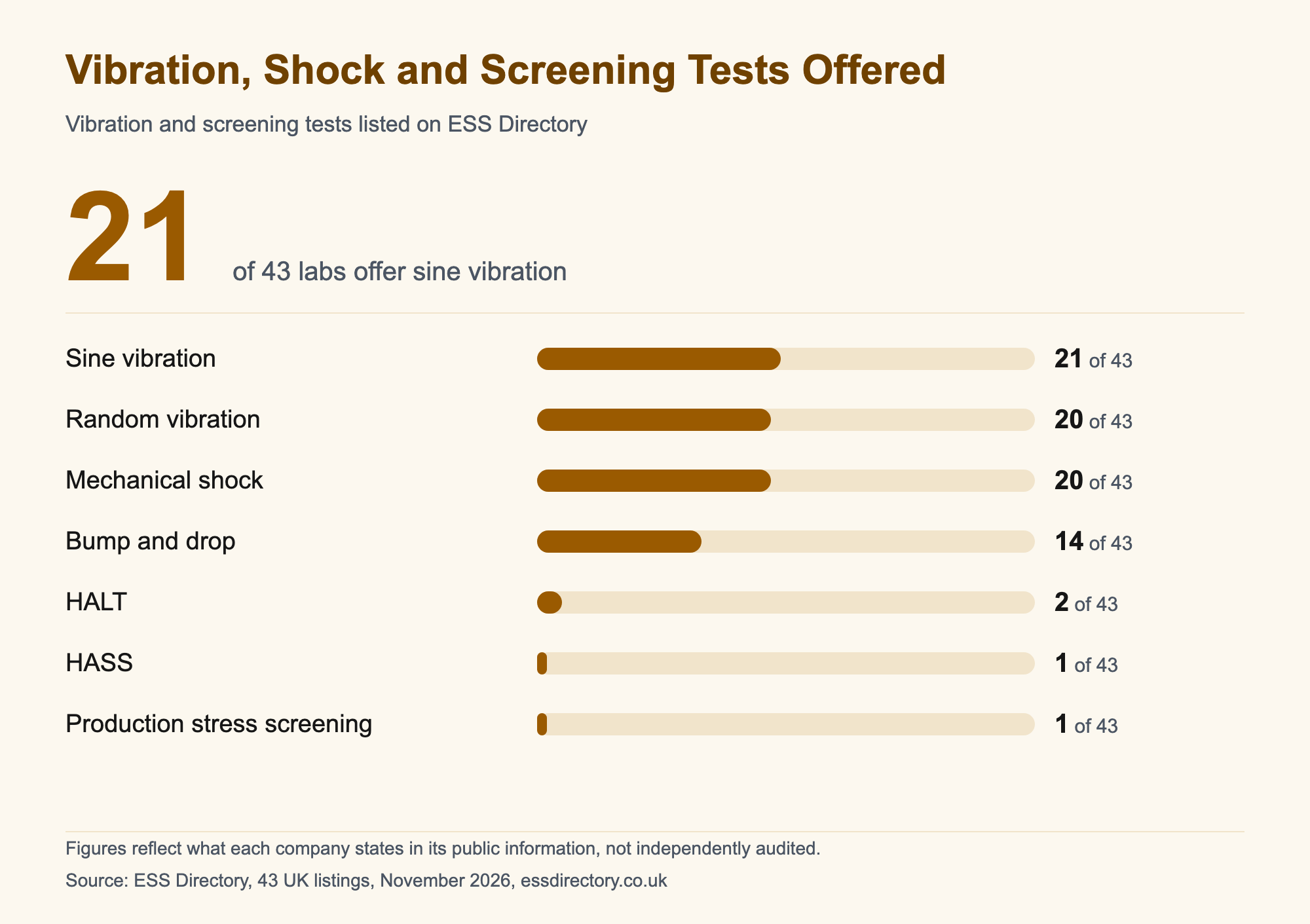
Vibration is the other. 21 of the labs list sine vibration, 20 random vibration and 20 mechanical shock, compared with 2 for HALT, 1 for HASS and 1 for production stress screening. Specialist HALT and HASS chambers are a different class of equipment from a conventional climatic chamber and shaker, so ask early whether the lab you want has the right chamber and how many slots it has.
What to ask a lab
- Is the chamber a dedicated HALT and HASS chamber, and what are its temperature range and rate of change?
- How many axes of vibration does it apply and at what levels?
- Who designs the fixture and the monitoring set-up for powering and checking the product during the test?
- For HASS: who derives the screening profile, and how is it proved on good units before production use?
- What does the report contain: the steps, the limits found, the failures and their analysis?
Quick-reference checklist
- Use HALT in development to find limits, not to pass or fail
- Derive a HASS or screening profile from those limits and prove it on good units
- Keep qualification tests for proving the design against the specification
- Ask labs about specialist chambers, fixtures and monitoring before you book
Figures come from ESS Directory listings as of November 2026 and reflect what each company states in its public information. They are not independently audited.
Where to go for more
UKAS publishes accreditation schedules for test labs. Military handbooks such as MIL-HDBK-344 describe environmental stress screening of electronic equipment.
Find stress screening labs on ESS Directory
Browse HALT, HASS and stress screening labs, along with climatic, temperature and humidity testing and vibration and shock testing. Save the labs that fit to your shortlist and send one enquiry to the whole shortlist at once. Our guide to choosing a UK environmental test lab covers the wider questions to ask.
Figures and data in this article are drawn from ESS Directory's own dataset of UK environmental test lab listings, and may be cited with attribution to ESS Directory and a link to this article.
For press enquiries about ESS Directory, contact ess@essdirectory.co.uk.
Listings related to this article

1g Dynamics
Royston, Hertfordshire
1g Dynamics in Royston runs a UKAS-accredited test house for vibration and climatic testing alongside its vibration system support work. It carries out sine and random vibration, half-sine, sawtooth and trapezoidal shock, high and low temperature, thermal cycling, damp heat and combined temperature and vibration tests to BS EN 60068, MIL-STD-810 and RTCA DO-160. The test house is accredited to ISO 17025, lab number 6508. Capacity includes shakers of up to 55.6 kN and a 1,700-litre climatic chamber covering -70°C to +180°C. The company works with aerospace, automotive, rail and motorsport customers.
- Temperature (Hot/Cold)
- Humidity/Damp Heat
- Thermal Cycling
- Combined Climatic and Vibration

3C Test
Silverstone, Northamptonshire
3C Test in Silverstone is an Applus+ Laboratories EMC and environmental test lab serving automotive, EV battery, aerospace and defence, and consumer and industrial electronics customers. Its environmental work covers high and low temperature, thermal shock, thermal cycling, humidity, salt spray, altitude, sine and random vibration, shock, drop and topple, and combined climatic and vibration testing. Standards include BS EN 60068, ISO 16750, MIL-STD-810, DEF STAN 00-35, RTCA DO-160 and EN 61373. It is UKAS-accredited to ISO 17025, lab number 1204. A 200 kN shaker can be combined with a large climatic chamber for EV battery pack testing.
- Temperature (Hot/Cold)
- Humidity/Damp Heat
- Thermal Cycling
- Thermal Shock

Alphatech
Haverhill, Suffolk
Alphatech in Haverhill runs an independent UKAS-accredited environmental test lab alongside its chamber sales, hire and service business. The lab covers high and low temperature, damp heat, thermal shock, sine and random vibration, shock, bump, drop and topple, HALT and HASS, IP dust and water ingress up to IPX9K, neutral salt spray and altitude. Standards include BS EN 60068, IEC 60529, ISO 20653, ISO 16750, MIL-STD-810, DEF STAN 00-35, RTCA DO-160 and EN 61373. It is accredited to ISO 17025, lab number 2645, with shakers of up to 40 kN. Customers can stay on site during testing.
- Temperature (Hot/Cold)
- Humidity/Damp Heat
- Thermal Cycling
- Thermal Shock

Element Warwick
Warwick, Warwickshire
Element Warwick, in Warwick, is an environmental test laboratory running climatic, dynamic and ingress protection tests. Climatic work covers high and low temperature, humidity, thermal shock, altitude to 35 mbar, driving sand and dust, driving rain, icing and salt corrosion. Dynamic work covers sine and random vibration on a shaker with 160 kN peak thrust, vibration at high and low temperature, classical shock, bump, drop and topple, and acceleration. IP testing covers IP5X to IPX8. Standards include IEC 60068, MIL-STD-810, DEF STAN 00-35, IEC 61373 and IEC 60529. It is UKAS-accredited to ISO 17025, lab number 31737, and serves aerospace, defence, energy and industrial sectors.
- Temperature (Hot/Cold)
- Humidity/Damp Heat
- Thermal Shock
- Combined Climatic and Vibration

Environmental Test Services (ETS)
Reading, Berkshire
Environmental Test Services is an independent, owner-managed environmental test laboratory in Reading, Berkshire. It runs vibration, shock, temperature and humidity, altitude and decompression, salt spray and IP testing, including combined temperature and vibration, thermal shock, icing and drop tests. Work is carried out to DEF STAN 00-35, MIL-STD-810, RTCA DO-160 and the IEC 60068 series, with IP testing to IEC 60529. The laboratory is UKAS-accredited to ISO 17025, lab number 1909. Facilities include a walk-in climatic chamber of 1.8 m x 2.4 m x 2.4 m and electromagnetic vibrators of up to 28 kN. Tested product types include aerospace, marine, satellite, telecoms and motor vehicle equipment.
- Temperature (Hot/Cold)
- Humidity/Damp Heat
- Thermal Cycling
- Thermal Shock
HORIBA MIRA Basildon
Basildon, Essex
HORIBA MIRA Basildon, at Quatro Park in Basildon, Essex, tests components and systems under vibration, climatic cycling, thermal shock, mechanical shock, corrosion and ingress protection. Facilities include 13 environmental chambers from 180 to 2,000 litres, two 36,000-litre walk-in chambers, electromagnetic vibrators and large battery shakers, including an IMV K350 with 900 kN shock thrust. Work is carried out to IEC 60068, MIL-STD-810, DEF STAN 00-35 and RTCA DO-160, including electric vehicle battery packs and modules. The site is UKAS-accredited to ISO 17025, lab number 2654, and serves the automotive, defence and aerospace sectors.
- Temperature (Hot/Cold)
- Humidity/Damp Heat
- Thermal Cycling
- Thermal Shock

Leonardo Environmental Test Lab (Edinburgh)
Edinburgh
Leonardo Environmental Test Lab in Edinburgh carries out climatic, dynamic and EMC testing at Leonardo UK's Crewe Toll site. Climatic tests cover high and low temperature from -60°C to +180°C, damp heat, thermal shock, altitude to 100,000 ft, rapid decompression, solar radiation, salt mist, immersion, drip and fluid contamination. Dynamic tests include sine and random vibration on shakers up to 13,000 lbf, combined temperature and vibration, shock, bump and drop. Standards include IEC 60068, MIL-STD-810, DEF STAN 00-35, RTCA DO-160 and EN 61373. The lab is UKAS-accredited to ISO 17025, lab number 0461, with climatic chambers up to 4 m x 1.5 m x 1.8 m.
- Temperature (Hot/Cold)
- Humidity/Damp Heat
- Thermal Cycling
- Thermal Shock

PARC (Product Assessment & Reliability Centre)
Bideford, Devon
PARC (Product Assessment & Reliability Centre) in Bideford, Devon, is an environmental test laboratory and part of the Apave group through Sopemea. It runs high and low temperature, damp heat, thermal shock, altitude, icing, rain, salt spray, IP, vibration, shock, bump and drop tests to IEC 60068, MIL-STD-810, DEF STAN 00-035, RTCA DO-160, ISO 16750 and EN 61373. The lab is UKAS-accredited to ISO 17025, lab number 2379. Capacity includes temperature chambers of up to 2.7 m x 2.7 m x 2.7 m and a vibration system with 89 kN random force. It serves aerospace, defence, automotive, rail, marine, oil and gas and telecoms customers.
- Temperature (Hot/Cold)
- Humidity/Damp Heat
- Thermal Cycling
- Thermal Shock

Reltech
Dursley, Gloucestershire
Reltech in Dursley, Gloucestershire, is an independent test laboratory for semiconductor devices and electronic components. It runs high and low temperature operating life and storage tests, temperature and power cycling, temperature-humidity bias (THB) and HAST moisture testing, burn-in screening, ESD and latch-up testing and failure analysis. Work follows JEDEC JESD22 methods and AEC-Q100 qualification requirements. The laboratory is UKAS-accredited to ISO 17025, lab number 2806, and also designs and builds its own HTOL systems. It serves automotive, aerospace and defence, space, medical and telecommunications customers, as well as AI and power device makers.
- Temperature (Hot/Cold)
- Humidity/Damp Heat
- Thermal Cycling
- Production Stress Screening

Resonate Testing
Newry, County Down
Resonate Testing in Newry provides vibration, shock, climatic, ingress protection, battery and fire testing from a single facility. Tests include sine and random vibration with combined climatic conditioning, classical and pyroshock, drop, temperature, humidity, thermal shock, altitude to 100,000 ft, IP dust and water, salt spray, sand and dust, rain and fluid susceptibility. Main standards are IEC 60068, MIL-STD-810, RTCA DO-160, DEF STAN 00-35, ISO 16750 and IEC 60529. The lab is UKAS-accredited to ISO 17025, lab number 9373, and is an ISTA Certified Laboratory. Capacity includes a 70 kN shaker. It serves space, aerospace, defence, automotive, energy, medical and industrial customers.
- Temperature (Hot/Cold)
- Humidity/Damp Heat
- Thermal Cycling
- Thermal Shock
Rivencore Global Solutions
Poole, Dorset
Rivencore Global Solutions in Poole offers environmental testing from its laboratory on the south coast. Tests include dry heat, low temperature, change of temperature and humidity in a 1,500-litre climatic chamber covering -70°C to +180°C, IP dust and water ingress from IP5X and IPX1 to IPX8, drop testing up to 15 kg, mechanical strength testing and HALT with combined random vibration and temperature stress. Main standards are IEC 60068, IEC 60529, MIL-STD-810, BS EN 60945 and IEC 62368-1. The laboratory is UKAS-accredited to ISO 17025, lab number 28772.
- Temperature (Hot/Cold)
- Humidity/Damp Heat
- Thermal Cycling
- Bump and Drop

TÜV SÜD Fareham
Fareham, Hampshire
TÜV SÜD Fareham runs climatic and vibration environmental test facilities at its Hampshire headquarters alongside EMC, radio and electrical safety labs. Its tests cover high and low temperature, damp heat, thermal shock, altitude, rapid decompression, salt corrosion, icing, fluid contamination, water ingress to IPX8, sine and random vibration, shock, drop and transit testing, to standards including IEC 60068, MIL-STD-810, DEF STAN 00-35, RTCA DO-160 and EN 61373. The lab is UKAS-accredited to ISO 17025, lab number 0141. Capacity includes climatic chambers up to 5.0 m x 6.0 m x 4.0 m and shakers up to 151 kN. Product groups served include aerospace, defence, rail, marine, satellites and medical devices.
- Temperature (Hot/Cold)
- Humidity/Damp Heat
- Thermal Cycling
- Thermal Shock

UTAC UK - Leyland
Preston, Lancashire
UTAC UK Leyland, at Aston Way in Leyland, Lancashire, offers component environmental testing alongside vehicle interior and heavy-vehicle dynamic testing. Its accredited scope covers high and low temperature, thermal shock, steady and cyclic humidity, salt spray, sine and random vibration at ambient or with temperature, and classical shock and bump, to IEC 60068, ASTM B117 and ISO 9227. The lab is UKAS-accredited to ISO 17025, lab number 10121. Capacity includes climatic chambers up to 3 m x 4 m x 6 m, a 40 kN electrodynamic shaker and hydraulic vibration rigs up to 250 kN. Product groups include motor vehicles, aerospace, rail, marine and telecommunications equipment.
- Temperature (Hot/Cold)
- Humidity/Damp Heat
- Thermal Shock
- Combined Climatic and Vibration

ZF Automotive UK Test & Validation
Solihull, West Midlands
ZF Automotive UK Test & Validation in Solihull offers EMC, environmental and materials testing for automotive and other industry components. Its environmental scope covers dry heat, low temperature, humidity, thermal cycling and thermal shock, salt mist, IP dust and water to IPX9K, icing, fluid contamination, low pressure, and sine, random, shock, bump and drop testing, with combined temperature and vibration. Standards include IEC 60068, MIL-STD-810, DEF STAN 00-35, RTCA DO-160, ISO 16750 and EN 61373. The lab is UKAS-accredited to ISO 17025, lab number 0332. Capacity includes 2,500-litre climatic chambers and a 66 kN shaker. It serves automotive, aerospace and rail.
- Temperature (Hot/Cold)
- Humidity/Damp Heat
- Thermal Cycling
- Thermal Shock